



Table of Contents
National Coding Week is a useful prompt to look at how work moves through your business, from software approvals and shared files to automation, data handling, and security habits. Basic coding literacy helps your team ask better questions before a workflow turns into a ticket backlog.
Eric Thibodeaux, Co-Founder at infoTECH Solutions, notes: “Treat coding literacy as workflow literacy, so staff can spot repeated data entry, risky shortcuts, and unclear system handoffs before they slow the business.”
Coding awareness matters more as software work changes. LLMs moved from 40% to >80% on SWE-bench Verified in one year, while another report shows performance rising from 60% to near 100%. You do not need every employee writing code. You need staff who can spot friction, explain it clearly, and make better technology decisions.
National Coding Week Gives You A Practical Checkpoint For Business Operations
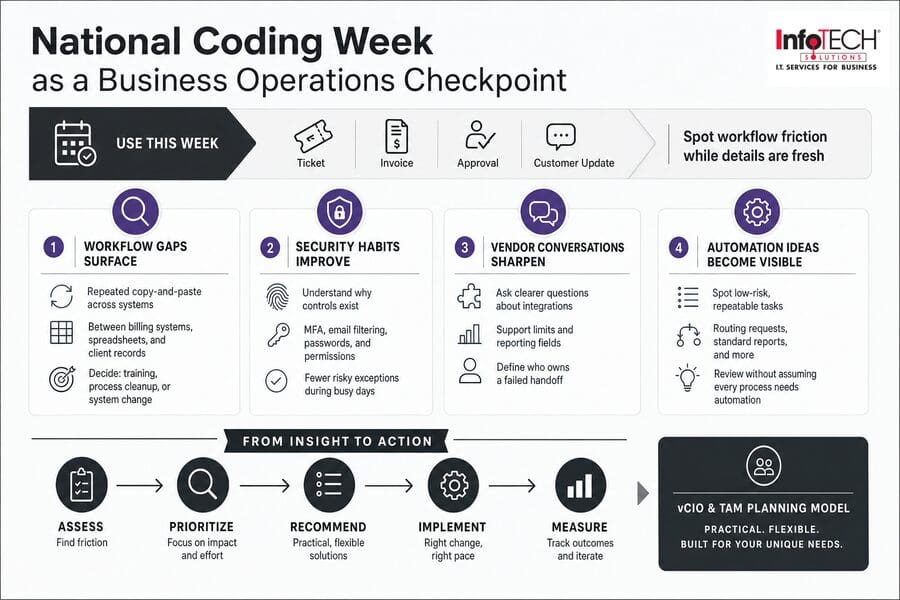
Use this week to find workflow friction while the details are fresh, especially where a ticket, invoice, approval, or customer update waits on a manual step.
-
Workflow gaps surface: Staff see repeated copy-and-paste work between billing systems, spreadsheets, and client records, making it easier to decide whether the fix is training, process cleanup, or a system change.
-
Security habits improve: When users understand why MFA, email filtering, passwords, and permissions exist, they make fewer risky exceptions during busy days.
-
Vendor conversations sharpen: Your team can ask clearer questions about app integrations, support limits, reporting fields, and who owns a failed handoff.
-
Automation ideas become visible: Low-risk tasks, such as routing requests or standardizing reports, can be reviewed without assuming every process needs automation.
Our vCIO and TAM planning model keeps recommendations practical, aligned to daily operations, and flexible to your unique needs.
Coding Awareness Helps Uncover Everyday System Bottlenecks
A finance team exports invoice data from one cloud app, cleans it in a spreadsheet, then rekeys totals into accounting before month-end. One missed column delays billing, and the support ticket says only that the report is wrong.
These bottlenecks rarely look technical at first. An office manager waits on access approvals for a new hire while shared folders, Microsoft 365 groups, and line-of-business apps are handled separately. A department lead chases updates across email and spreadsheets because notifications do not reach the right person. The result: delays.
Coding awareness helps staff describe the handoff, not write the software. Managed IT services, IT support and helpdesk, network support, remote monitoring, backup monitoring, Microsoft 365 support, and SaaS protection all work better when the workflow is visible.
A National Week For Coding Can Strengthen Cyber Readiness
Cybersecurity improves when staff understand how systems behave during ordinary work, such as opening a spreadsheet, approving cloud access, sharing a client file, or restoring data after an outage.
-
Permissions control daily access: The wrong access exposes files and slows cleanup when an employee changes roles. Review shared drives, finance apps, and cloud folders before exceptions pile up.
-
Scripts can change systems: Unexpected macros, prompts, and downloads deserve caution because they can alter files or settings. Pause before clicking.
-
Backups protect work continuity: Failed backups turn a restore request into a longer recovery timeline. Our 24/7/365 cybersecurity support includes monitoring, restores, and disaster recovery planning.
-
Cloud apps need oversight: SaaS tools affect data retention, file sharing, and customer service follow-up. Password pressure is real, with the average person having around 100 passwords.
-
Training reduces repeat tickets: Password reuse, including 72% among Gen Z and 42% among Boomers, shows why practical training matters. infoTECH Solutions is Cyber Verify™ AA Rated, MSP Verify™ certified, and A+ accredited with the Better Business Bureau.
|
Coding concept |
Business risk signal |
Operational control |
Primary owner |
|---|---|---|---|
|
Conditional logic in login workflows |
A user signs in from an unfamiliar country after normal office hours |
Require two-factor authentication and create a Microsoft Entra ID alert for impossible travel |
IT security analyst |
|
Input validation on web forms |
A customer service form receives scripts or malformed text in comment fields |
Block executable input, log the submission, and route the incident to the ticketing queue |
Application owner |
|
Version control for shared files |
A finance spreadsheet is overwritten before payroll approval |
Enable SharePoint version history and require manager approval for restored payroll files |
Finance operations manager |
|
API connections between SaaS tools |
A CRM exports customer records to an unapproved marketing platform |
Review OAuth app permissions monthly and revoke unused third-party integrations |
Sales operations lead |
|
Error handling in automated jobs |
A nightly backup reports “completed” but skips encrypted folders |
Test restore samples weekly and escalate failed backup logs to 24/7/365 cybersecurity support |
Systems administrator |
Build Better, Safer Digital Operations
Build Coding Awareness Into IT Planning
Change is hard when deadlines, tickets, client work, and compliance tasks are already waiting. Small, structured actions work better than a one-time training announcement because they connect learning to the systems your staff use every day.
-
Map one manual process: Pick a recurring workflow in each department, such as invoice approval or client intake, and mark every place staff reenter data.
-
Review access permissions: Check shared drives, cloud apps, finance systems, and client platforms for users who no longer need access.
-
Gather staff friction points: Ask employees for the top three technology frustrations slowing their day, then group them by system, process, or training need.
-
Prioritize one practical improvement: Choose one low-risk automation, integration, or training update with a clear owner and deadline.
Demand for technical judgment keeps growing, with projected growth over the national rate for Data Scientists and Data Analysts at 420%, Cybersecurity Analysts and Engineers at 346%, and Software Developers and Engineers at 188%. Our vCIO and TAM help turn that pressure into educated IT decisions that fit your systems, staff capacity, budget, and risk profile, without pushing services you do not need.
Turn Coding Awareness Into Better Workflows
Use National Coding Week to pinpoint process gaps, automation opportunities, and IT risks with guidance from infoTECH Solutions.
Turn A Coding Skills Week Into Measurable Follow-Through
Coding awareness should leave you with fewer manual workarounds, clearer technology decisions, stronger cyber habits, smoother support requests, and better continuity planning.
The next useful outcome may be a cleaner approval workflow, a tighter access review, a backup restore test, or a better way for staff to submit tickets with the system name, file location, and deadline included.
For practical next steps, contact infoTECH Solutions. We have served businesses in southwestern Louisiana for 20+ years, with offices along the I-10 corridor in Lafayette and Jennings, and we can help you improve workflows, cyber readiness, and technology planning in a way that fits your needs.